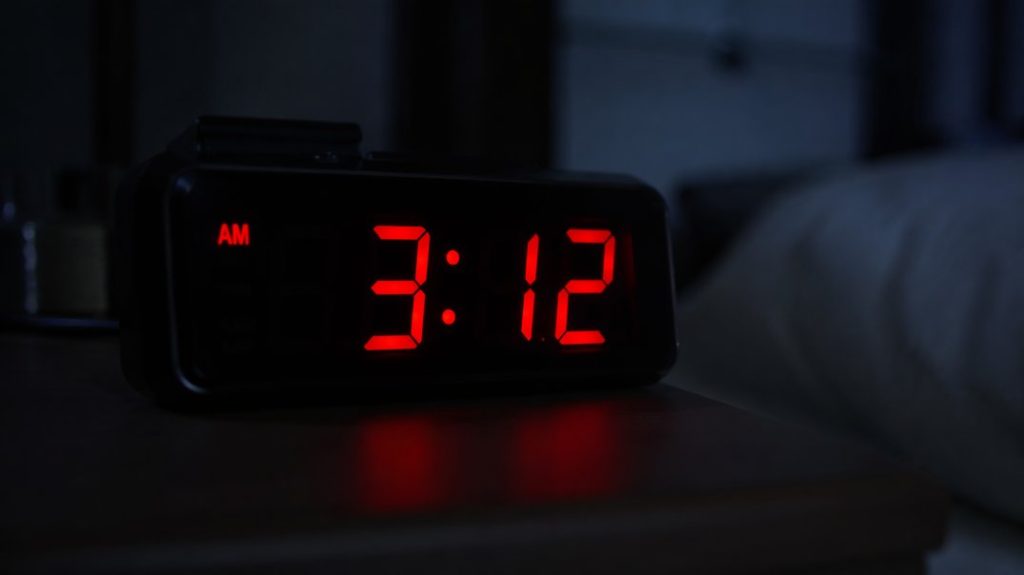
It is oddly specific how consistent this complaint is. Not “I sleep badly now,” but a precise, repeatable pattern: asleep by 11, wide awake at 3, mind suddenly alert as if someone flipped a switch. If this sounds familiar, you have probably already tried the obvious fixes, a cooler room, less wine at dinner, and still found yourself staring at the ceiling at the same hour, night after night.
There is a real physiological story behind this pattern, and it is more specific than “hormones are all over the place.” A few distinct changes tend to overlap during perimenopause, and together they make an early, wide-awake waking far more likely than it would have been a decade earlier.
Key Takeaways
- Perimenopause is linked to a genuine shift in the timing of your internal body clock, not just a general disruption of sleep.
- Cortisol, the hormone that naturally rises before you wake, has been linked in research to worse objective sleep architecture in perimenopausal and postmenopausal women.
- Independent of hot flashes, research has found a pattern of increased brain arousal during sleep in postmenopausal women, which may make waking easier in general.
- Morning light exposure and a consistent wake time are among the most effective tools for addressing the underlying clock shift, not just the symptom.
Your Internal Clock Shifts Earlier During Perimenopause
One of the more overlooked explanations for early waking is not about being woken up by something, it is about your internal clock quietly resetting itself to an earlier schedule.
A Genuine Circadian Phase Advance
Research comparing postmenopausal and premenopausal women has documented something called a circadian phase advance, essentially a forward shift in the body’s internal timing. One controlled study using activity monitoring, wrist temperature tracking, cortisol profiles, and sleep lab recordings found that postmenopausal women showed a circadian phase advance of roughly one hour, along with lower rhythm amplitude and greater overall circadian instability, compared to premenopausal women.
Why This Makes Early Waking More Likely
A body clock running an hour ahead does not just move your bedtime earlier. It moves your entire sleep window earlier, including the point where your sleep naturally becomes lighter and easier to wake from. If your body now treats 3 a.m. the way it used to treat 4 a.m., an early, wide-awake waking stops being a mystery and starts looking like a predictable consequence of a shifted clock.
Cortisol’s Role in Early Morning Waking
Cortisol is often blamed for the 3 a.m. wake-up, and there is real research behind that connection, though it is more nuanced than most articles about it suggest.
The Normal Cortisol Rhythm
Cortisol naturally follows a diurnal pattern, rising in the hours before you wake to help prepare your body for the day and dropping to its lowest point overnight. That rise is a normal part of every person’s sleep cycle, not unique to perimenopause.
What the Research Actually Shows
A study using overnight sleep lab recordings and repeated blood sampling in perimenopausal and postmenopausal women found that higher cortisol levels were associated with objectively worse sleep architecture, including lower sleep efficiency, less slow-wave sleep, and more awakenings. Interestingly, the same study found no clear link between cortisol levels and how tired or insomnia-prone women reported feeling. That is a meaningful, honest detail: the hormonal mechanism appears to be real at the level of measurable sleep quality, even though it does not map perfectly onto how any individual woman feels or describes her own sleep.
Why Your Sleep Feels Lighter Than It Used To
There is a third piece to this picture that has nothing to do with hot flashes at all. A long-term study following women through the menopausal transition, part of the Study of Women’s Health Across the Nation, found that women who transitioned to postmenopause showed a pattern of increased brain arousal during sleep, independent of whether they reported hot flashes. In plain terms, the brain itself appears to shift toward a lighter, more easily-woken state during this transition, on top of whatever else is happening with temperature or hormones. That helps explain why even nights without an obvious trigger, no night sweat, no stressful day, can still end in an abrupt early waking.
Other Contributors Worth Knowing About
The clock shift, cortisol, and brain arousal patterns above are the best-supported explanations, but a couple of other factors are commonly involved too.
Progesterone Decline and a Weaker Off Switch
Progesterone has a mild calming effect on the brain through its influence on GABA, a calming neurotransmitter. As progesterone becomes erratic during perimenopause, that natural nightly calming effect becomes less reliable, which can make it easier for any of the factors above to actually result in a full waking rather than a brief, unnoticed shift in sleep stage.
Night Sweats and Blood Sugar
For some women, a night sweat is the direct trigger behind a 3 a.m. waking, since the discomfort and temperature spike are enough to pull you out of sleep on their own. Blood sugar dips overnight are also commonly proposed as a trigger, since a drop in glucose can prompt a stress hormone response. This idea is physiologically plausible and widely repeated, but it has been studied less rigorously in perimenopausal women specifically than the circadian and cortisol mechanisms above, so it is worth treating as a reasonable possibility rather than a settled explanation.

What Can Help With 3am Waking
Because more than one mechanism is usually involved, the most effective approach tends to address the clock itself, not just the moment of waking.
Anchor Your Circadian Clock
Getting bright light, ideally outdoors, within the first thirty to sixty minutes of waking is one of the most effective tools for stabilizing a shifted circadian rhythm. Keeping a consistent wake time daily, even on weekends, reinforces that signal and gives your internal clock a steady anchor to work from, rather than letting it drift further.
Support the Physiological Side
A cooler bedroom addresses the night sweat piece directly. Magnesium may help support the nervous system’s ability to stay settled through the night, given its role in calming brain activity.
| Contributor | What’s Happening | What Helps |
|---|---|---|
| Circadian phase advance | Internal clock shifts roughly an hour earlier | Morning light, consistent wake time |
| Cortisol rhythm | Linked to worse objective sleep architecture | Consistent sleep-wake schedule, stress management |
| Increased brain arousal | Lighter, more easily-woken sleep state | Sleep hygiene fundamentals, magnesium |
| Night sweats | Direct temperature-driven waking | Cooler bedroom, moisture-wicking bedding |
When to Talk to a Doctor About Early Morning Waking
If 3 a.m. wakings are happening most nights, are not improving with consistent habit changes, or are leaving you exhausted and struggling to function the next day, it is worth bringing up with a doctor. Hormone therapy and other prescription options have real evidence behind them for perimenopausal sleep disruption, and there is no reason to manage this alone for months or years if a well-studied treatment could help sooner.
Frequently Asked Questions
Is Waking Up at the Same Time Every Night a Sign of a Health Problem?
Not necessarily. During perimenopause, a consistent early waking time is often linked to a genuine shift in your internal body clock rather than a separate health issue, though it is still worth mentioning to a doctor if it is significantly affecting your daily life.
Does Cortisol Really Cause the 3am Wake-Up?
Research has found a link between higher cortisol levels and worse objective sleep quality in perimenopausal and postmenopausal women, though the same research found no clear connection between cortisol and how tired women reported feeling. It appears to be a real contributing mechanism, not the whole explanation on its own.
Will This Get Better Over Time?
Sleep patterns often continue to shift throughout the menopausal transition and can improve for many women after menopause is complete, though this varies quite a bit from person to person. In the meantime, addressing the circadian and lifestyle factors above tends to help regardless of where you are in the transition.
Selected Sources
- Sleep Disturbances in Menopause: Neuroendocrine Mechanisms and Clinical Implications
- Worse Sleep Architecture but Not Self-Reported Insomnia and Sleepiness Is Associated With Higher Cortisol Levels in Menopausal Women, ScienceDirect
- Influence of the Menopausal Transition on Polysomnographic Sleep Characteristics: A Longitudinal Analysis, Sleep Journal / National Library of Medicine
This article is for general educational purposes and is not a substitute for personalized medical advice. Talk with a qualified healthcare provider about symptoms and treatment options specific to you.