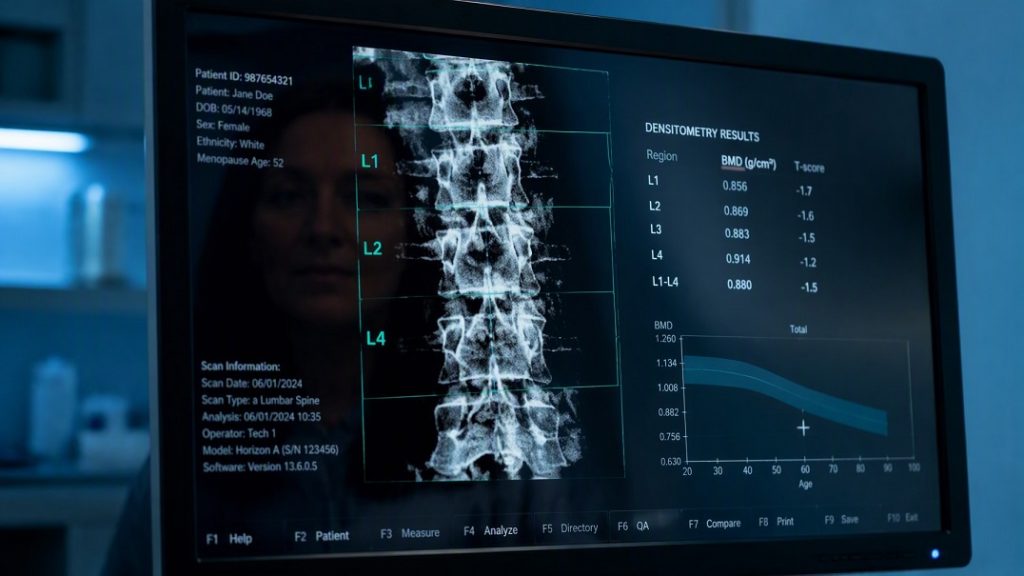
Bone density scans are not part of most routine physicals in your 40s, which can leave you wondering whether you should be asking for one or simply waiting to be told. The honest answer is that it depends on your age and personal risk factors, and the guidelines on this shifted somewhat recently.
Here is what current screening recommendations actually say, and how to think about whether earlier testing makes sense for you.
Key Takeaways
- The U.S. Preventive Services Task Force recommends screening all women 65 and older, with earlier screening for postmenopausal women under 65 who have elevated fracture risk.
- A bone density scan, or DXA, is quick, painless, and involves a low dose of radiation, similar to a routine X-ray.
- If you have risk factors like a family history of osteoporosis, early menopause, a low body weight, or a history of fracture, it is worth raising the topic of earlier screening with your doctor rather than waiting.
What the Current Guidelines Actually Say
The U.S. Preventive Services Task Force updated its osteoporosis screening recommendation in 2025. It continues to recommend that all women 65 and older be screened for osteoporosis, and it recommends screening for postmenopausal women younger than 65 who are found to be at increased risk through a clinical risk assessment. This is a moderate net benefit recommendation, meaning the task force found reasonably strong evidence that screening this population helps more than it harms.
The Two-Step Approach for Women Under 65
For postmenopausal women younger than 65, the task force suggests a two-step process. First, a clinician checks for risk factors such as parental history of hip fracture, low body weight, smoking, or heavy alcohol use. If one or more of those factors is present, a formal risk assessment tool, most often FRAX, is used to estimate fracture probability and decide whether a scan is warranted now rather than later. This means there is no single fixed age at which every woman under 65 should get scanned. It is a risk-based decision rather than a blanket rule.
Risk Factors That Might Justify Earlier Testing
A few specific circumstances are worth bringing up with your doctor even if you are well under 65:
Early or Surgical Menopause
Menopause before age 45, whether natural or from surgery such as ovary removal, means a longer stretch of estrogen deficiency and, correspondingly, more years of accelerated bone loss before the age when screening typically begins. This is one of the clearer cases for earlier testing.
Low Body Weight or a History of Disordered Eating
Lower body weight is consistently associated with lower bone density, partly because there is less mechanical loading on the skeleton and partly through hormonal pathways. A history of significant caloric restriction, whether recent or years in the past, is also relevant information to share with a doctor.

Long-Term Steroid Use or Certain Medical Conditions
Medications like long-term oral corticosteroids, along with conditions such as rheumatoid arthritis, celiac disease, hyperthyroidism, or chronic kidney disease, can accelerate bone loss independent of the menopause transition. If any of these apply to you, this is a reasonable, specific reason to ask about earlier screening rather than waiting for a standard age cutoff.
A Previous Fragility Fracture
A broken bone from a fall at standing height or less, sometimes called a fragility fracture, is itself a signal that warrants a bone density evaluation at any age, since this kind of fracture would not typically happen with normal bone strength.
What a DXA Scan Actually Involves
A dual-energy X-ray absorptiometry scan, usually shortened to DXA or DEXA, is a low-radiation imaging test that typically measures bone density at the hip and lumbar spine. It takes about 10 to 20 minutes, requires no special preparation beyond avoiding calcium supplements the day of the test, and involves lying still on a table while a scanning arm passes over you. The radiation exposure is very low, comparable to a small fraction of a standard chest X-ray.
| Group | Screening Guidance |
|---|---|
| Women 65 and older | Routine screening recommended |
| Postmenopausal women under 65, no risk factors | Screening not routinely recommended yet |
| Postmenopausal women under 65 with risk factors | Risk assessment, then screening if indicated |
| Any age, with a fragility fracture | Screening recommended regardless of age |
How to Bring This Up With Your Doctor
If you are under 65 and think you might have risk factors worth discussing, mentioning them plainly is usually the most effective approach: family history, menopause timing, weight history, medications, and any prior fractures. Doctors are generally receptive to this conversation, and a bone density scan is a low-risk, informative test rather than something that requires extensive justification to request.
Frequently Asked Questions
Do I Need a Bone Density Scan in My 40s?
Not routinely, unless you have specific risk factors like early menopause, long-term steroid use, a low body weight, or a prior fragility fracture. Without those factors, current guidelines generally place screening starting points later, though this is a reasonable topic to raise with your doctor if you are unsure where you stand.
Is a Bone Density Scan Painful or Risky?
No. A DXA scan is painless, quick, and involves a very low dose of radiation, considerably less than a standard X-ray. There is no recovery time needed and no sedation involved.
How Often Should Screening Be Repeated?
This depends on your initial results and risk profile. Women with normal bone density are often rescreened every few years, while those with osteopenia, particularly toward the lower end of that range, may be rechecked sooner, sometimes every one to two years, to track the trend over time.
Selected Sources
- USPSTF: Screening for Osteoporosis to Prevent Fractures, 2025 Recommendation
- Healthy People 2030: Osteoporosis Screening
- Screening for Osteoporosis to Prevent Fractures: Evidence Review for USPSTF (NCBI Bookshelf)
This article is for general educational purposes and is not a substitute for personalized medical advice. Talk with a qualified healthcare provider about whether bone density screening is appropriate for you and when.