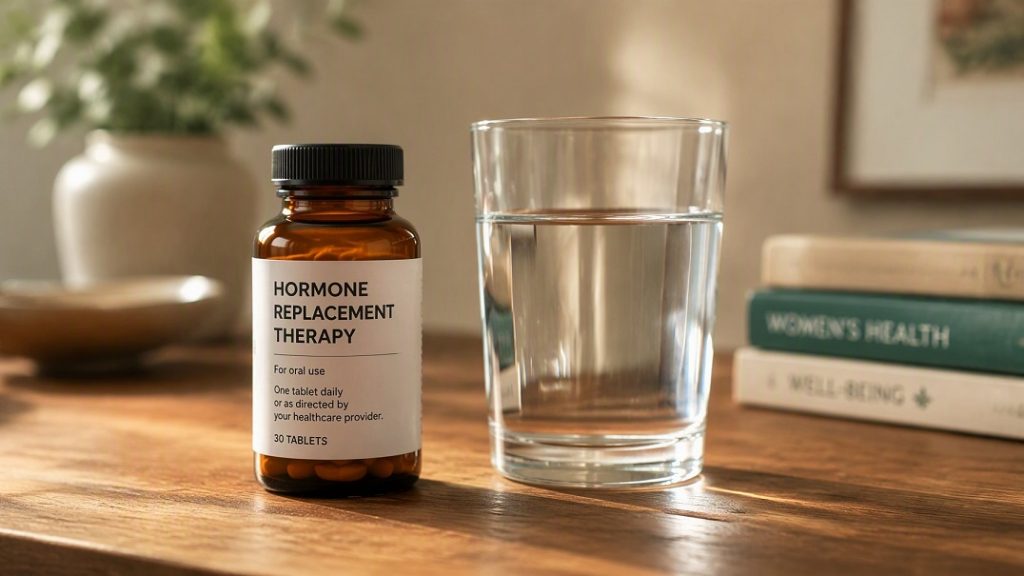
Few menopause topics carry as much confusion, and as much outdated fear, as hormone replacement therapy. Many women’s understanding of it is still shaped by news coverage from decades ago, without the more nuanced picture that has emerged since. This guide is meant to explain what HRT actually is, in plain language, so you can have a more informed conversation with your doctor rather than starting from old headlines.
This article describes how HRT works and what current medical guidelines say. It is not a recommendation for or against it for you specifically, that decision belongs in a conversation with your own doctor.
Key Takeaways
- Hormone replacement therapy replaces estrogen, and usually progesterone, to relieve menopause symptoms and protect bone density.
- The North American Menopause Society considers HRT the most effective available treatment for hot flashes and genitourinary symptoms of menopause.
- The benefit-risk balance depends heavily on your age and how many years have passed since menopause, and is generally most favorable for women under 60 or within 10 years of menopause onset.
- “Bioidentical” and “compounded” are not the same thing, and understanding the difference matters for both safety and regulation.
What HRT Actually Does
At its core, HRT replaces the hormones, primarily estrogen, that your ovaries produce less of during and after the menopause transition. Hormone therapy remains the most effective treatment for vasomotor symptoms, meaning hot flashes and night sweats, and for genitourinary syndrome of menopause, and has been shown to prevent bone loss and fracture.
Why Progesterone Is Usually Included
Traditional HRT typically combines estrogen and progesterone, since the addition of progesterone helps prevent a thickening of the uterine lining called endometrial hyperplasia in women who still have a uterus. Women who have had a hysterectomy generally do not need this added protection and may be prescribed estrogen alone.
The Different Forms HRT Comes In
This is where a lot of confusion sets in, because several different questions, what hormone, what route, and whether it’s FDA-approved, often get collapsed into a single decision when they are really separate considerations.
Systemic Versus Local
Systemic estrogen is absorbed into the bloodstream and works throughout the body, addressing symptoms like hot flashes and night sweats, while local estrogen works primarily where it is applied, most often used for vaginal dryness and related symptoms with minimal absorption elsewhere in the body.
Delivery Methods
Systemic HRT can be administered orally as a pill, vaginally, or transdermally through a patch, gel, or spray, each with somewhat different benefits and considerations. A pill passes through the digestive system and liver before reaching general circulation, while a patch or gel delivers hormone directly through the skin, bypassing that initial liver processing.
Bioidentical Versus Compounded
These two terms get used almost interchangeably in casual conversation, but they answer different questions. Bioidentical describes the hormone’s molecular structure, and many FDA-approved products meet that definition. Compounded simply means custom-made by a specialty pharmacy and not FDA-approved. It is worth being clear that bioidentical does not automatically mean compounded, since FDA-approved products like standard estradiol and micronized progesterone are themselves bioidentical.
| Term | What It Actually Means |
|---|---|
| Systemic | Absorbed into bloodstream, treats whole-body symptoms |
| Local (vaginal) | Works primarily at the application site, minimal systemic absorption |
| Bioidentical | Molecularly identical to hormones your body naturally produces |
| Compounded | Custom-made by a specialty pharmacy, not FDA-approved or standardized |
| FDA-approved | Tested and regulated, with standardized dosing |
Who HRT Tends to Make the Most Sense For
This is genuinely a matter of individual risk and benefit, not a one-size-fits-all answer, and current guidelines are explicit about that. For women younger than 60 or within 10 years of menopause onset who have no contraindications, the benefit-risk ratio is favorable for treating bothersome vasomotor symptoms and preventing bone loss. For women who start hormone therapy more than 10 years after menopause onset, or who are older than 60, the balance appears less favorable because of greater absolute risks of coronary heart disease, stroke, blood clots, and dementia.
What the Actual Risks Look Like
It helps to see real numbers rather than vague warnings. The increased absolute risks associated with combined estrogen-progestogen therapy and estrogen-only therapy are rare, generally fewer than 10 per 10,000 women per year, and include increased risk for blood clots and gallbladder disease. Combined therapy also carries a rare increased risk for stroke and breast cancer. Separately, absolute risks are actually reduced for all-cause mortality, fracture, and diabetes in women younger than 60, and breast cancer risk specifically is reduced with estrogen-only therapy in this same younger group.
Frequently Asked Questions
Is Bioidentical Hormone Therapy Safer Than Traditional HRT?
Not necessarily, and this is a common misconception. Many FDA-approved, standard HRT products are themselves bioidentical. The meaningful safety distinction is between FDA-approved products, which are tested and standardized, and compounded products, which are not subject to the same regulatory oversight.
Does HRT Definitely Increase Breast Cancer Risk?
It depends on the type and how long it’s used. Current guidelines note that breast cancer risk does not increase appreciably with short-term use of combined estrogen-progestogen therapy, and may actually decrease with estrogen-only therapy. Risk profiles vary by individual health history, which is why this is a conversation to have directly with your doctor.
How Long Can Someone Stay on HRT?
There is no universal cutoff. Current guidelines support longer duration for documented needs like persistent hot flashes, combined with periodic reevaluation and shared decision-making between a woman and her doctor, rather than an automatic time limit.
Selected Sources
- The North American Menopause Society: The 2022 Hormone Therapy Position Statement
- NCBI StatPearls: Hormone Replacement Therapy
- NAMS Hormone Therapy Position Statement 2022, Guideline Summary
This article is for general educational purposes and is not a substitute for personalized medical advice. Talk with a qualified healthcare provider about symptoms and treatment options specific to you.