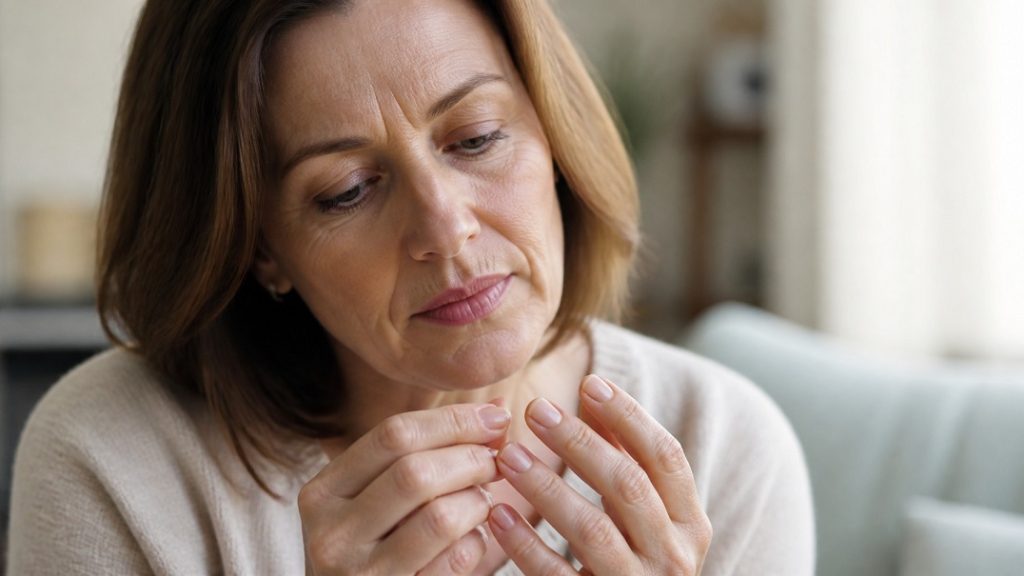
If your nails used to grow strong and now split, peel, or snap at the slightest catch on a sweater, you are dealing with something that has both a hormonal explanation and a very ordinary, fixable one. Brittle nail syndrome becomes noticeably more common after 40, and it rarely has just one cause.
The good news is that nails, unlike hair or skin, respond relatively quickly to correction once you identify what is actually driving the problem, because a full nail grows out in about six months.
Key Takeaways
- Declining estrogen thins the nail plate and reduces its ability to retain moisture, making brittleness more common after 40.
- External factors like frequent hand washing, harsh chemicals, and acetone-based polish remover often make hormonal changes worse.
- Biotin has the most consistent clinical evidence among nail-specific supplements, though studies remain small.
- Because nails grow slowly, expect to wait three to six months before judging whether any intervention is working.
The Hormonal Piece
Nails are made largely of keratin, and their structure depends on adequate hydration and a well-organized connective tissue base at the nail bed. As estrogen declines, collagen production in that connective tissue drops as well, leading to thinner, more fragile nails that also tend to grow more slowly. This hormonal shift is a recognized contributor to the brittle, dehydrated nails many women notice around midlife.
Reduced blood flow to the extremities, another common midlife change, can also limit how efficiently nutrients reach the nail bed, compounding the effect.
External Factors That Make It Worse
Hormonal changes rarely act alone. Frequent water exposure is one of the most common contributors to nail brittleness, since repeated expansion and contraction of the nail plate weakens the bonds between its keratin layers. This affects anyone who washes dishes often, swims regularly, or works with their hands in water.
Chemical Exposure
Harsh cleaning products, acetone-based nail polish remover, and frequent gel manicures strip the nail’s natural oils and can accelerate splitting. None of these causes are specific to menopause, but they layer on top of a nail plate that is already more vulnerable due to hormonal changes, which is why brittleness can feel disproportionate to any single habit.

Nutritional Deficiencies Worth Checking
Iron deficiency, biotin insufficiency, and zinc deficiency are the nutrient links most consistently associated with brittle nails, and a focused blood panel, including ferritin, zinc, and thyroid function, is a reasonable first step before assuming the cause is purely cosmetic or purely hormonal.
Thyroid Involvement
Both an underactive and overactive thyroid can cause nail changes, including brittleness, ridging, and slower growth. Because thyroid conditions become more common in the same age range as perimenopause, this is worth ruling out, particularly if nail changes are accompanied by fatigue or unexplained weight changes.
What Has Actual Evidence Behind It
Among the many nail supplements marketed for brittleness, biotin has the most consistently reported clinical evidence, even though most of the underlying trials are small. A foundational study found that 63 percent of patients with brittle nails improved on 2.5 milligrams of biotin daily, with roughly a 25 percent increase in nail plate thickness over six months. A separate scanning electron microscopy study confirmed a similar pattern, finding nail thickness increased significantly by 25 percent in the group receiving biotin, along with reduced splitting and a more regular cellular structure at the nail surface.
It is worth noting these studies were small and not always fully controlled, so the effect size should be read with some caution rather than treated as definitive. Zinc plays a more foundational, structural role, supporting the keratin production and cell division that nails depend on, and correcting a genuine zinc deficiency has reasonable support for improving related nail changes, though the direct clinical trial evidence specifically for nails is thinner than for biotin.
Practical Steps That Help Regardless of Cause
Wearing gloves for dishwashing and cleaning, choosing acetone-free polish remover, and applying a nourishing cuticle oil after hand washing address the external layer of the problem directly. These steps are inexpensive, low-risk, and worth doing even while you investigate hormonal or nutritional causes in parallel.
What to Skip or Limit
Frequent gel or acrylic manicures are worth reconsidering if brittleness has become a real problem. The application and removal process, particularly buffing the nail surface and soaking in acetone, mechanically thins the nail plate over repeated cycles. Giving nails an occasional break between manicures allows the plate to rebuild some of its natural thickness, even while other interventions are still working in the background.
| Cause | How Common | What Helps |
|---|---|---|
| Estrogen decline | Very common after 40 | Moisture protection, medical evaluation for HRT if appropriate |
| Water and chemical exposure | Very common, often overlooked | Gloves, acetone-free remover, cuticle oil |
| Biotin deficiency or low intake | Variable | Biotin supplementation, most evidence of the nutrients studied |
| Iron or zinc deficiency | Variable | Blood testing, targeted supplementation |
Frequently Asked Questions
How Long Does It Take to See Improvement in Brittle Nails?
Because nails grow slowly, roughly three to four millimeters a month, most clinical studies evaluated improvement over three to six months. Expect to give any intervention that long before judging whether it is working.
Is Biotin Worth Trying for Brittle Nails?
It has more consistent supporting evidence than most other nail supplements, with studies showing improved thickness and reduced splitting over about six months. That said, the underlying trials are small, so results vary and it is not guaranteed to help everyone.
Could My Brittle Nails Be a Sign of a Thyroid Problem?
Possibly. Both hypothyroidism and hyperthyroidism can cause nail changes, and this is worth mentioning to your doctor, especially if brittleness is accompanied by fatigue, temperature sensitivity, or unexplained weight changes.
Selected Sources
- PubMed: Biotin for the Treatment of Nail Disease, What Is the Evidence?
- PubMed: Treatment of Brittle Fingernails and Onychoschizia With Biotin
- GoodRx: Does Menopause Make Your Nails Brittle and Dehydrated?
This article is for general educational purposes and is not a substitute for personalized medical advice. Talk with a qualified healthcare provider about symptoms and treatment options specific to you.